Wednesday, June 22, 2011
What Is Abnormal Psychology?
Abnormal psychology is the branch of psychology that studies unusual patterns of behavior, emotion and thought, which may or may not be understood as precipitating a mental disorder. Some occupations like counselors, clinical psychologists and psychotherapists work exactly in this field.
Before we know about what the meaning of abnormal psychology is, we should to know what is the meaning of “abnormal”? Abnormal is not normal, not typical usual or regular or conforming to a norm. But now we are not talking about the norms of a particular group, gender or age. The people are called as an abnormal is they who do something that out of the other people’s behavior.
Normal and abnormal is definitely different. Normal and abnormal is not always having similar connotation as good or bad. Sometimes like someone who is genius, we can call them as the people who has abnormal thing. In this case, this abnormal is mean something’s good. If that abnormal behavior is making someone feel annoyed or it would disturb the other people, it is also called as abnormal psychology and it maybe need some health mental interventions.
Some psychologists or psychiatrists may focus on a single perspective, but many mental health professionals may use or focus to multiple perspectives in order to getting a better treatment for the client. There are some approaches that are used by the mental health professionals. First, that is behavioral approach. It just focuses on the client behavior not the main causes. Second, that is medical approach. It focuses on the mental or the biological illness of the client. It might include genetic inheritance, related physical disorders, infections and chemical imbalances. Third, cognitive approach, it is focus on the client’s internal thought, perception, and reasoning contributes.
How are the abnormal psychologies disorders categorized and defined? The American Psychiatric Association published The Diagnostic and Statistical Manual of Mental Disorders and mental health professionals used it for a variety of purposes. For the question, what are the categories of psychology disorder? Categories of psychological disorders include: Adjustment Disorders, Mood Disorders, Anxiety Disorders, Developmental Disorders, and Cognitive Disorders.
As we know from the information before, the abnormal psychology is not always a bad thing, sometimes it would be a good one. But, if someone have an abnormal behavior which strange and it indicated as something that make someone feel annoyed, so it can be called as the abnormal behavior that need some treatments from the health mental professional.
What Is Abnormal Psychology?
Before we know about what the meaning of abnormal psychology is, we should to know what is the meaning of “abnormal”? Abnormal is not normal, not typical usual or regular or conforming to a norm. But now we are not talking about the norms of a particular group, gender or age. The people are called as an abnormal is they who do something that out of the other people’s behavior.
Normal and abnormal is definitely different. Normal and abnormal is not always having similar connotation as good or bad. Sometimes like someone who is genius, we can call them as the people who has abnormal thing. In this case, this abnormal is mean something’s good. If that abnormal behavior is making someone feel annoyed or it would disturb the other people, it is also called as abnormal psychology and it maybe need some health mental interventions.
Some psychologists or psychiatrists may focus on a single perspective, but many mental health professionals may use or focus to multiple perspectives in order to getting a better treatment for the client. There are some approaches that are used by the mental health professionals. First, that is behavioral approach. It just focuses on the client behavior not the main causes. Second, that is medical approach. It focuses on the mental or the biological illness of the client. It might include genetic inheritance, related physical disorders, infections and chemical imbalances. Third, cognitive approach, it is focus on the client’s internal thought, perception, and reasoning contributes.
How are the abnormal psychologies disorders categorized and defined? The American Psychiatric Association published The Diagnostic and Statistical Manual of Mental Disorders and mental health professionals used it for a variety of purposes. For the question, what are the categories of psychology disorder? Categories of psychological disorders include: Adjustment Disorders, Mood Disorders, Anxiety Disorders, Developmental Disorders, and Cognitive Disorders.
As we know from the information before, the abnormal psychology is not always a bad thing, sometimes it would be a good one. But, if someone have an abnormal behavior which strange and it indicated as something that make someone feel annoyed, so it can be called as the abnormal behavior that need some treatments from the health mental professional.
Wednesday, June 8, 2011
ABNORMAL PSYCHOLOGY BOOKS COLLECTION
On this section i will share you about Abnormal Psychology Books, there's a lot book discuss about abnormal psychology, but i only share good/best book i know....

Bleeding to Ease the Pain: Cutting, Self-Injury, and the Adolescent Search for Self {Abnormal Psychology Series}
"Plante features the stories of self-injurers and helps the reader understand the meaning of the injuries, and how to help teens stop" Lori G. Plante
 Abnormal Psychology {Edition 14}
"introduces a striking new design, new topics, fresh insights, streamlined writing, and a sharper focus on research in psychopathology have emerged" James N. Butcher
 Fundamentals of Abnormal Psychology {Edition 6}
"Expanded multicultural coverage including new sociocultural landscape boxes, Expanded coverage of key disorders and topics such as Borderline Personality Disorder, Conduct Disorder, ADHD, Pervasive Developmental Disorders like Asperger s Disorder
Expanded coverage of prevention and of the promotion of mental health" Ronald J. Comer
 Abnormal Psychology: An Integrated Approach {Edition 6}
"Show you how psychological disorders are rooted in multiple factors: biological, psychological, cultural, social, familial, and even political. You can test your understanding of topics with the text's built-in concept checks and chapter quizzes. Then, watch the book's integrated case studies come to life with Abnormal Psychology CourseMate, which provides real case profiles to give you a realistic context for the scientific findings of the book." David H. Barlow, V. Mark Durand
ABNORMAL PSYCHOLOGY BOOKS COLLECTION

Bleeding to Ease the Pain: Cutting, Self-Injury, and the Adolescent Search for Self {Abnormal Psychology Series}
"Plante features the stories of self-injurers and helps the reader understand the meaning of the injuries, and how to help teens stop" Lori G. Plante

"introduces a striking new design, new topics, fresh insights, streamlined writing, and a sharper focus on research in psychopathology have emerged" James N. Butcher

"Expanded multicultural coverage including new sociocultural landscape boxes, Expanded coverage of key disorders and topics such as Borderline Personality Disorder, Conduct Disorder, ADHD, Pervasive Developmental Disorders like Asperger s Disorder
Expanded coverage of prevention and of the promotion of mental health" Ronald J. Comer

"Show you how psychological disorders are rooted in multiple factors: biological, psychological, cultural, social, familial, and even political. You can test your understanding of topics with the text's built-in concept checks and chapter quizzes. Then, watch the book's integrated case studies come to life with Abnormal Psychology CourseMate, which provides real case profiles to give you a realistic context for the scientific findings of the book." David H. Barlow, V. Mark Durand
Sunday, June 5, 2011
aBnoRmAl PSYCHOLOGY Short Description - Mental Disorder
Abnormal psychology or mental disorder is examine about psychological disorder which can be determined by they appearance (symptoms), why they ensue (etiology), how to take care of, and what consequence they have on people’s lives.
 Psychological disorder usually ensue infrequently, has unusual act, characterized by misery, and tend to be precarious. It relevance with sets of actions or manner (symptoms) that generate a functional which can be consequence in debasement in people’s lives.
Psychopatology spins around two main points of paradigms for illuminating pschycological disorder, the psychological paradigm and the biological paradigm. The theories which concentrate about humanistic are include on psychological paradigm, meanwhile cognitive and behavioral are reasons and consequences of psychopathology. Whereas, assumptions which reveal more on physical factors, such as genetics and neurochemistry are embrace on the biological paradigm. For instance, hunter-gatherer societies, animists who supposed that people representing unusual act are possessed by wicked spirits.
This thought has been linked with trepanation, which means the rehearsal of cutting a hole into the individual's skull in turn to emit the wicked spirits. Those are several justification by societies about Phsycological disorder.
only on Bachelor in Psychology source : Abnormal Psychology
aBnoRmAl PSYCHOLOGY Short Description - Mental Disorder
Psychopatology spins around two main points of paradigms for illuminating pschycological disorder, the psychological paradigm and the biological paradigm. The theories which concentrate about humanistic are include on psychological paradigm, meanwhile cognitive and behavioral are reasons and consequences of psychopathology. Whereas, assumptions which reveal more on physical factors, such as genetics and neurochemistry are embrace on the biological paradigm. For instance, hunter-gatherer societies, animists who supposed that people representing unusual act are possessed by wicked spirits.
This thought has been linked with trepanation, which means the rehearsal of cutting a hole into the individual's skull in turn to emit the wicked spirits. Those are several justification by societies about Phsycological disorder.
only on Bachelor in Psychology source : Abnormal Psychology
Thursday, January 27, 2011
THE NEW PSYCHOLOGY OF LOVE
The New Psychology of Love - Interesting Title isn't it ? This book presents the full range of psychological theories on lovebiological, taxonomical, implicit, cultural with the latest research of love and friendship, offer a comprehensive and engaging comparison of contemporary data and theories on Psychology of love.
The book Focusing not on a single point of view but on the entire range of current theories.
Thursday, January 20, 2011
PERFECTIONISM TEST - Perfectionism in Psychology
Perfectionism Test - Perfectionism in Psychology, find out your obsessive personality types. in Psychology Perfectionism is a belief that perfection can and should be attained. In its pathological form, perfectionism is a belief that work or output that is anything less than perfect is unacceptable. At such levels, this is considered an unhealthy belief, and psychologists typically refer to such individuals as maladaptive perfectionists.
Perfectionism can drive people to accomplishments and provide the motivation to persevere in the face of discouragement and obstacles its an extreme of Conscientiousness and can provoke increasing Neuroticism as the perfectionist's expectations are not met.
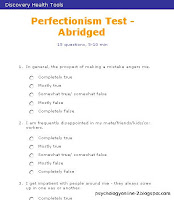
You Can tested it, are you perfectionism or not on Discoveryhealth : Perfectionism Test Abridge just answer 15 Questions and done!. Good Luck
PERFECTIONISM TEST - Perfectionism in Psychology
Perfectionism can drive people to accomplishments and provide the motivation to persevere in the face of discouragement and obstacles its an extreme of Conscientiousness and can provoke increasing Neuroticism as the perfectionist's expectations are not met.
You Can tested it, are you perfectionism or not on Discoveryhealth : Perfectionism Test Abridge just answer 15 Questions and done!. Good Luck
Thursday, December 30, 2010
GRAPHIC GUIDE MIND AND BEHAVIOR - PSYCHOLOGY EBOOK

Psychology Ebook A Graphic Guide to Your Mind And Behavior by Nigel Benson, on this book, you will learn about what is psychology and other psych history, explore psychology study and on the other words, its "an Introduction Knowledge about psychology" explaining what the subject has been in the past and what it is now
The sections within psychology are described, including Introspection, Bio psychology, Psychoanalysis, Behaviorism, Comparative Animal Psychology, Cognitive Approaches , Social Psychology
Tuesday, November 23, 2010
Dialectical Behavior Therapy DBT Simple Description
Dialectical behavior therapy DBT is a system of therapy originally developed to treat persons with borderline personality disorder by Marsha M. Linehan, a psychology researcher at the University of Washington.
DBT combines standard cognitive-behavioral techniques for emotion regulation and reality-testing with concepts of distress tolerance, acceptance, and mindful awareness largely derived from Buddhist meditative practice.
Dialectical behavior therapy is the first therapy that has been experimentally demonstrated to be effective for treating BPD. it also effective in treating patients who present varied symptoms and behaviors associated with spectrum mood disorders, including self-injury. Recent work suggests its effectiveness with sexual abuse survivors and chemical dependency.
Dialectical behavior therapy involves:
Neither component is used by itself; the individual component is considered necessary to keep suicidal urges or uncontrolled emotional issues from disrupting group sessions, while the group sessions teach the skills unique to DBT, and also provide practice with regulating emotions and behavior in a social context.
Check out Dialectical Behavior Therapy Video By Jeffrey Wood. PsyD
Dialectical Behavior Therapy DBT Simple Description
DBT combines standard cognitive-behavioral techniques for emotion regulation and reality-testing with concepts of distress tolerance, acceptance, and mindful awareness largely derived from Buddhist meditative practice.
Dialectical behavior therapy is the first therapy that has been experimentally demonstrated to be effective for treating BPD. it also effective in treating patients who present varied symptoms and behaviors associated with spectrum mood disorders, including self-injury. Recent work suggests its effectiveness with sexual abuse survivors and chemical dependency.
Dialectical behavior therapy involves:
- An individual component in which the therapist and patient discuss issues that come up during the week, recorded on diary cards, and follow a treatment target hierarchy. Self-injurious and suicidal behaviors take first priority, followed by therapy interfering behaviors. Then there are quality of life issues and finally working towards improving one's life generally. During the individual therapy, the therapist and patient work towards improving skill use. Often, a skills group is discussed and obstacles to acting skillfully are addressed.
- The group, which ordinarily meets once weekly for two to two-and-a-half hours, learns to use specific skills that are broken down into four modules: core mindfulness skills, interpersonal effectiveness skills, emotion regulation skills, and distress tolerance skills.
Neither component is used by itself; the individual component is considered necessary to keep suicidal urges or uncontrolled emotional issues from disrupting group sessions, while the group sessions teach the skills unique to DBT, and also provide practice with regulating emotions and behavior in a social context.
Check out Dialectical Behavior Therapy Video By Jeffrey Wood. PsyD
Subscribe to:
Posts (Atom)


