Thursday, January 27, 2011
THE NEW PSYCHOLOGY OF LOVE
The New Psychology of Love - Interesting Title isn't it ? This book presents the full range of psychological theories on lovebiological, taxonomical, implicit, cultural with the latest research of love and friendship, offer a comprehensive and engaging comparison of contemporary data and theories on Psychology of love.
The book Focusing not on a single point of view but on the entire range of current theories.
Thursday, January 20, 2011
PERFECTIONISM TEST - Perfectionism in Psychology
Perfectionism Test - Perfectionism in Psychology, find out your obsessive personality types. in Psychology Perfectionism is a belief that perfection can and should be attained. In its pathological form, perfectionism is a belief that work or output that is anything less than perfect is unacceptable. At such levels, this is considered an unhealthy belief, and psychologists typically refer to such individuals as maladaptive perfectionists.
Perfectionism can drive people to accomplishments and provide the motivation to persevere in the face of discouragement and obstacles its an extreme of Conscientiousness and can provoke increasing Neuroticism as the perfectionist's expectations are not met.
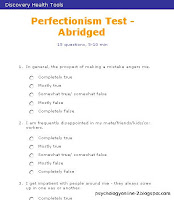
You Can tested it, are you perfectionism or not on Discoveryhealth : Perfectionism Test Abridge just answer 15 Questions and done!. Good Luck
PERFECTIONISM TEST - Perfectionism in Psychology
Perfectionism can drive people to accomplishments and provide the motivation to persevere in the face of discouragement and obstacles its an extreme of Conscientiousness and can provoke increasing Neuroticism as the perfectionist's expectations are not met.
You Can tested it, are you perfectionism or not on Discoveryhealth : Perfectionism Test Abridge just answer 15 Questions and done!. Good Luck
Thursday, December 30, 2010
GRAPHIC GUIDE MIND AND BEHAVIOR - PSYCHOLOGY EBOOK

Psychology Ebook A Graphic Guide to Your Mind And Behavior by Nigel Benson, on this book, you will learn about what is psychology and other psych history, explore psychology study and on the other words, its "an Introduction Knowledge about psychology" explaining what the subject has been in the past and what it is now
The sections within psychology are described, including Introspection, Bio psychology, Psychoanalysis, Behaviorism, Comparative Animal Psychology, Cognitive Approaches , Social Psychology
Tuesday, November 23, 2010
Dialectical Behavior Therapy DBT Simple Description
Dialectical behavior therapy DBT is a system of therapy originally developed to treat persons with borderline personality disorder by Marsha M. Linehan, a psychology researcher at the University of Washington.
DBT combines standard cognitive-behavioral techniques for emotion regulation and reality-testing with concepts of distress tolerance, acceptance, and mindful awareness largely derived from Buddhist meditative practice.
Dialectical behavior therapy is the first therapy that has been experimentally demonstrated to be effective for treating BPD. it also effective in treating patients who present varied symptoms and behaviors associated with spectrum mood disorders, including self-injury. Recent work suggests its effectiveness with sexual abuse survivors and chemical dependency.
Dialectical behavior therapy involves:
Neither component is used by itself; the individual component is considered necessary to keep suicidal urges or uncontrolled emotional issues from disrupting group sessions, while the group sessions teach the skills unique to DBT, and also provide practice with regulating emotions and behavior in a social context.
Check out Dialectical Behavior Therapy Video By Jeffrey Wood. PsyD
Dialectical Behavior Therapy DBT Simple Description
DBT combines standard cognitive-behavioral techniques for emotion regulation and reality-testing with concepts of distress tolerance, acceptance, and mindful awareness largely derived from Buddhist meditative practice.
Dialectical behavior therapy is the first therapy that has been experimentally demonstrated to be effective for treating BPD. it also effective in treating patients who present varied symptoms and behaviors associated with spectrum mood disorders, including self-injury. Recent work suggests its effectiveness with sexual abuse survivors and chemical dependency.
Dialectical behavior therapy involves:
- An individual component in which the therapist and patient discuss issues that come up during the week, recorded on diary cards, and follow a treatment target hierarchy. Self-injurious and suicidal behaviors take first priority, followed by therapy interfering behaviors. Then there are quality of life issues and finally working towards improving one's life generally. During the individual therapy, the therapist and patient work towards improving skill use. Often, a skills group is discussed and obstacles to acting skillfully are addressed.
- The group, which ordinarily meets once weekly for two to two-and-a-half hours, learns to use specific skills that are broken down into four modules: core mindfulness skills, interpersonal effectiveness skills, emotion regulation skills, and distress tolerance skills.
Neither component is used by itself; the individual component is considered necessary to keep suicidal urges or uncontrolled emotional issues from disrupting group sessions, while the group sessions teach the skills unique to DBT, and also provide practice with regulating emotions and behavior in a social context.
Check out Dialectical Behavior Therapy Video By Jeffrey Wood. PsyD
Sunday, November 21, 2010
Approach Women In Public Place (NEW!) - Easy Tips
Approach Women in Public Places, recently i reading articles on Knol.Google.com i looking for a new psychology Theories, but i found this "Approach woman in Public Places" on Psychology Category, it remind me about Articles " How To Be Irresistible To Women" on the ebook you'll find a new way how to get women easily or how to Approach women in everywhere in different way, of course it relate with psychology concept and personality and Personal Attitude "Game".
Social psychologists explain human behavior as the result of social interactions coupled with our state of mind. This means how well you do in your social interactions in public places is influenced by the form of interactions you had with other people in the past. After all that interaction has made you who you are. And it is only right to think that you have picked up the right information and cues that teaches you how to interact with different group of people.
Here the list
Approach Women In Public Place (NEW!) - Easy Tips
Social psychologists explain human behavior as the result of social interactions coupled with our state of mind. This means how well you do in your social interactions in public places is influenced by the form of interactions you had with other people in the past. After all that interaction has made you who you are. And it is only right to think that you have picked up the right information and cues that teaches you how to interact with different group of people.
Here the list
- Factors that govern the outcome of making a move on women in public places.
- Personal attitudes.
- Persuasive talent.
- Adapting social cognitive methods to leave the right impression on the person.
- Methods on how to approach women in public places like parks.
- Go out and mingle with the crowed.
- Observe the women and learn their outdoor behavior.
- Show your warm smile.
- Strike a conversation.
- Evaluate her feedback.
Saturday, November 20, 2010
NINE PERSONALITY TYPES AT WORK
Nine Personality Types at work, so what types are you? Perfectionist, The Helper or The Visionary Types? i will write down list 9 Personality Types, this just information only, Generally, we all fall into one specific type. While it might see pieces of ourselves in other types, there is one type that overwhelming describes each one of us. Each type is neither good nor bad it's all about your style of relating.
PERFECTIONIST
Get things exactly right, idealistic, critical and judgmental. Make decisions with the thought that there is only one correct way to do it. Upright and high energy, have a tendency to nit-pick and micro-manage, but ultimately blame your self than others. have a clear vision of the way things should be.
People with Perfectionist type motivated by the need to live the "right way", always improve their self and others and avoid anger.
THE HELPER
The Helper sweet, sensitive, helpful and sometimes humble, road to power and influence involves making yourself indispensable to others. You are relationship-oriented. Although you can be manipulative, also inspirational and bring out the best in others.
People with The Helper type is motivated by the need to be loved and appreciated, expressing positive feelings in others, and avoid the impression of "need".
PURSUER ACHIEVER
Achiever Enthusiastic, efficient, high-performing and competitive, you are a can-do person who wants to be known for getting the job done. can be seen as a charismatic leader. You're a good team player and motivator, and very proud of your accomplishments. You know exactly how the world works and you know what to do about it.
People with Achiever motivated by the need to become a productive, successful, and avoid failure.
THE CONNOISSEUR
Love the beautiful, the true, the obscure and the unusual. romantic, creative, a bit melancholy, and can sometimes be elitist. often make decisions based on feeling. Some people see you as snooty, acerbic and critical, but you prefer to describe yourself as a patron of the arts and the finer things in life, elegant and tasteful.
People with the connoisseur types are motivated by the need to understand the feelings of ourselves and understand others, find meaning in life, and avoid self-image of mediocrity.
OBSERVERS
Like to be slightly removed from the rest, so you can watch the world from a safe distance while collecting facts, theories and information. You are independent and self-sufficient, and are sometimes considered distant. You can be brilliant, intense and committed.
People of observers type are motivated by the need to know everything and the universe, had enough with myself and keep my distance, and avoid looking foolish or has no answer.
WORRIER
You spend more time worrying about what could go wrong rather than dreaming about what is going right. you're paranoid. You're better on the defensive team than the offensive team. You're faithful, intuitive and committed, but you also tend to fret.
Motivated by the need to obtain approval, feel cared for, and avoid the impression the rebels.
ADVENTURER
Engaging, energetic and upbeat, you can be optimistic to a fault.You see things in terms of the best possible outcome. Sometimes you get so caught up in how things could be that you're unaware of how things are, and people can view you as irresponsible and narcissistic because of that. You prefer to be called an idealist.
motivated by the need to feel happy and plan fun things, contribute to the world, and to avoid suffering and sorrow.
FIGHTER
Power and control are your main goals, and you have the energy and cunning to achieve them. You never run from a fight or confrontation in fact, sometimes you seek them out. Nothing can keep you down for long, and you're capable of building an empire, but you are surprisingly protective
People with type of fighters are motivated by the need to be able to rely on ourselves, strong, giving effect to the world, and avoid the impression of weakness.
THE MEDIATOR
Confrontation and discord are your worst enemies, so you have become adroit at placating and pacifying. You are calm and good at compromise, and generally serve as the peacemaker in heated situations. You're in touch with the feelings of the group. Some people see you as ambiguous and indecisive.
motivated by the need to keep the peace, merge with others and avoid conflict.
That all The Nine Personality Types - Known yourself

NINE PERSONALITY TYPES AT WORK
PERFECTIONIST
Get things exactly right, idealistic, critical and judgmental. Make decisions with the thought that there is only one correct way to do it. Upright and high energy, have a tendency to nit-pick and micro-manage, but ultimately blame your self than others. have a clear vision of the way things should be.
People with Perfectionist type motivated by the need to live the "right way", always improve their self and others and avoid anger.
THE HELPER
The Helper sweet, sensitive, helpful and sometimes humble, road to power and influence involves making yourself indispensable to others. You are relationship-oriented. Although you can be manipulative, also inspirational and bring out the best in others.
People with The Helper type is motivated by the need to be loved and appreciated, expressing positive feelings in others, and avoid the impression of "need".
PURSUER ACHIEVER
Achiever Enthusiastic, efficient, high-performing and competitive, you are a can-do person who wants to be known for getting the job done. can be seen as a charismatic leader. You're a good team player and motivator, and very proud of your accomplishments. You know exactly how the world works and you know what to do about it.
People with Achiever motivated by the need to become a productive, successful, and avoid failure.
THE CONNOISSEUR
Love the beautiful, the true, the obscure and the unusual. romantic, creative, a bit melancholy, and can sometimes be elitist. often make decisions based on feeling. Some people see you as snooty, acerbic and critical, but you prefer to describe yourself as a patron of the arts and the finer things in life, elegant and tasteful.
People with the connoisseur types are motivated by the need to understand the feelings of ourselves and understand others, find meaning in life, and avoid self-image of mediocrity.
OBSERVERS
Like to be slightly removed from the rest, so you can watch the world from a safe distance while collecting facts, theories and information. You are independent and self-sufficient, and are sometimes considered distant. You can be brilliant, intense and committed.
People of observers type are motivated by the need to know everything and the universe, had enough with myself and keep my distance, and avoid looking foolish or has no answer.
WORRIER
You spend more time worrying about what could go wrong rather than dreaming about what is going right. you're paranoid. You're better on the defensive team than the offensive team. You're faithful, intuitive and committed, but you also tend to fret.
Motivated by the need to obtain approval, feel cared for, and avoid the impression the rebels.
ADVENTURER
Engaging, energetic and upbeat, you can be optimistic to a fault.You see things in terms of the best possible outcome. Sometimes you get so caught up in how things could be that you're unaware of how things are, and people can view you as irresponsible and narcissistic because of that. You prefer to be called an idealist.
motivated by the need to feel happy and plan fun things, contribute to the world, and to avoid suffering and sorrow.
FIGHTER
Power and control are your main goals, and you have the energy and cunning to achieve them. You never run from a fight or confrontation in fact, sometimes you seek them out. Nothing can keep you down for long, and you're capable of building an empire, but you are surprisingly protective
People with type of fighters are motivated by the need to be able to rely on ourselves, strong, giving effect to the world, and avoid the impression of weakness.
THE MEDIATOR
Confrontation and discord are your worst enemies, so you have become adroit at placating and pacifying. You are calm and good at compromise, and generally serve as the peacemaker in heated situations. You're in touch with the feelings of the group. Some people see you as ambiguous and indecisive.
motivated by the need to keep the peace, merge with others and avoid conflict.
That all The Nine Personality Types - Known yourself
Friday, November 19, 2010
Bachelor Degree in Psychology
Bachelor Degree in Psychology The Articles provide you with some information about potential employment opportunities after completing your psychology degree, but also to make some suggestions about how to handle occupational decisions and successfully land that first job.
The undergraduate major in psychology is a liberal arts degree, not a professional degree. It doesn't make you a psychologist or a professional counselor. These occupations require specific training at the graduate level and are regulated by state law. If such occupations interest you, be prepared to continue your education in graduate school.
While some occupations in psychology require graduate training, there are many interesting and rewarding career opportunities available to individuals with a bachelor's degree in psychology. Your selection of an appropriate occupation, however, requires some self-analysis and research. Ultimately, successful employment depends on your efforts to
► Make informed decisions about your career
► Learn about prospective occupations
► Acquire appropriate knowledge, skills, characteristics for such occupations
► Learn how to conduct a well-planned job search.
Makeup your mind About Your Career
Successful career planning requires careful and objective self-assessment, a realistic understanding of your aptitudes and skills, an awareness of responsibilities associated with potential employment settings, careful selection of experiences designed to develop marketable skills and knowledge, and an action plan for conducting a successful job search. Good luck
Bachelor Degree in Psychology
The undergraduate major in psychology is a liberal arts degree, not a professional degree. It doesn't make you a psychologist or a professional counselor. These occupations require specific training at the graduate level and are regulated by state law. If such occupations interest you, be prepared to continue your education in graduate school.
While some occupations in psychology require graduate training, there are many interesting and rewarding career opportunities available to individuals with a bachelor's degree in psychology. Your selection of an appropriate occupation, however, requires some self-analysis and research. Ultimately, successful employment depends on your efforts to
► Make informed decisions about your career
► Learn about prospective occupations
► Acquire appropriate knowledge, skills, characteristics for such occupations
► Learn how to conduct a well-planned job search.
Makeup your mind About Your Career
Successful career planning requires careful and objective self-assessment, a realistic understanding of your aptitudes and skills, an awareness of responsibilities associated with potential employment settings, careful selection of experiences designed to develop marketable skills and knowledge, and an action plan for conducting a successful job search. Good luck
Subscribe to:
Posts (Atom)


